Here’s a proper miscellaneous topic: The contents of a box of cameras passed down through my family.

I thought of these as “granny’s cameras” — my paternal grandmother was quite a keen photographer — but it turns out they came from a couple of different family branches.
They all date from a year or two either side of 1960, making them contemporary with the Minolta SR-1 SLR I wrote at length about a few years ago. But nobody in my family had an SLR at the time.
Left to right in the picture above, they are an Ilford Sportsman (c. 1962), a Zeiss Ikon Colora (c. 1960), and an Agfa Super Silette L (c. 1958). I think these were all pretty typical 35mm cameras for the UK at that time.

Ilford Sportsman
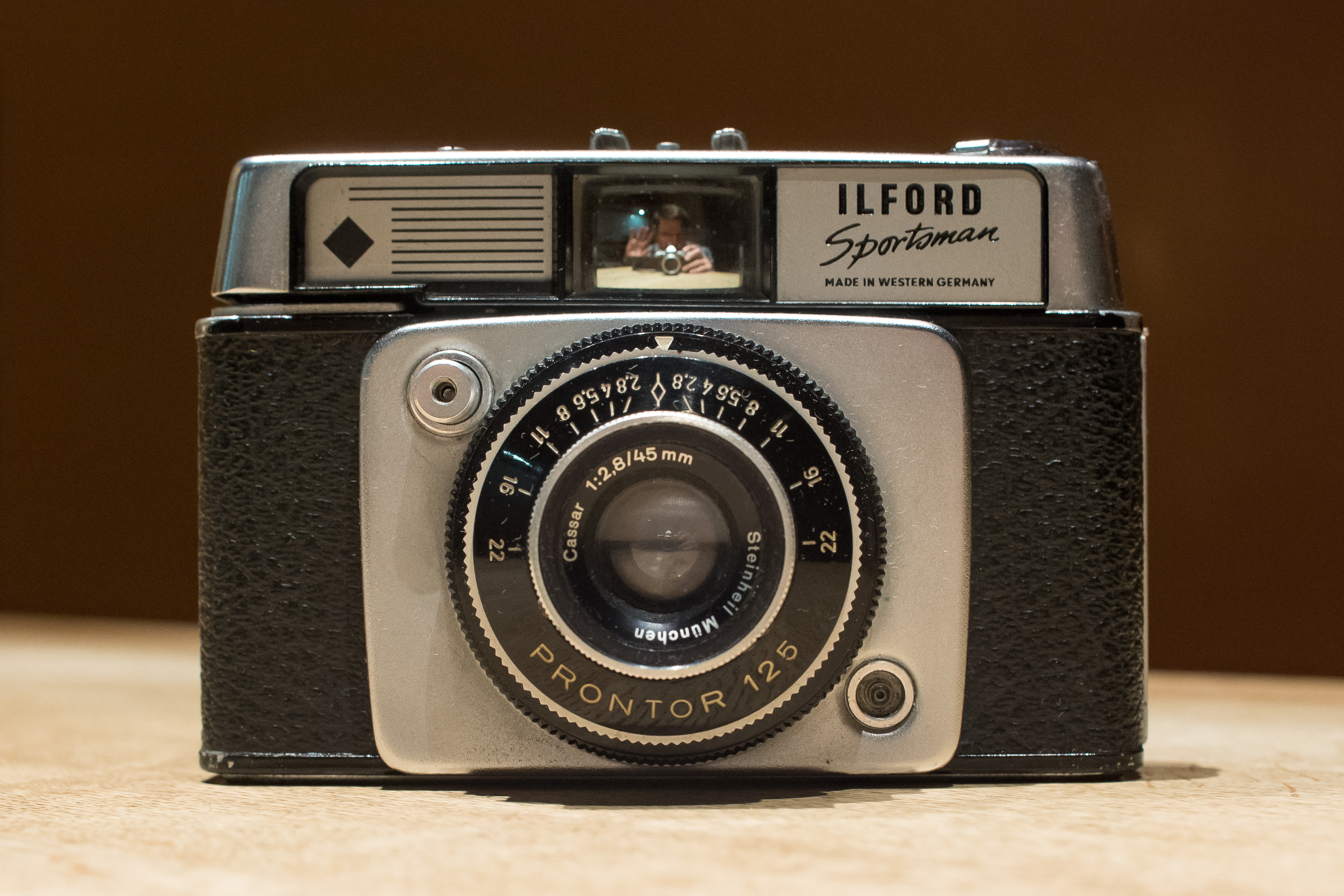
This appears to be a Sportsman “Mk IV” (“with fake rangefinder window“, the diamond on the top left). It belonged to one of my mother’s brothers, not from my the same side of the family as the granny whose cameras I thought these were. I know that because he carefully inscribed his name and address on the inside of the case. It’s the entry level model with no optional extras, but a proper camera like this must still have been a big deal for a teenager.
I like the mirrored viewfinder, allowing your subject to check their hair or makeup while you faff about framing the photo. The shutter button pushes in to the front of the camera, not an arrangement that has remained popular.
This one has an awkward combination of reasonably fast lens (f2.8) with very slow shutter (only three speeds, 1/30 to 1/125). With that shutter, one thing it isn’t suited for is sports.
It had a modern post-it note on the back saying “Shutter sticks – do not use”, so I haven’t.
Zeiss Ikon Colora

This camera from 1960 was 40 years ahead of its time in anticipating the millennial fascination with silver-coloured plastic! The plastic surround around the lens does seem a bit cheap, though that’s fair enough as, like the Sportsman, it was a budget model.
But this is actually a really neat camera, that has both sentimental and practical appeal to me. This one did belong to my granny. She put her name and address on a sticker on the back, and the most last update to it was over 20 years more recent than the camera. It’s surely the most used of the three.
I have used this one, it works well and can take a nice photo. It’s a pleasure to use, in fact, being a sensible size and weight with clear controls and a good viewfinder, with bright line guides but no focus assistance. The shutter button is in what I think of as the usual place, on the top right.
I’m definitely going to stick another film in this one and use it a bit more.
Agfa Super Silette L

No plastic trim here! This camera is a couple of years older than the others and would have been significantly more expensive. It’s gorgeous to look at. It has some proper mod-cons that the other two lack: a focus-coupled rangefinder, and a lightmeter of uncoupled match-needle type. Both are still accurate. The shutter is a delight — press down the lever, with its well-beyond-necessary bit of leather detail, and it fires with no effort and just a tiny soft “snick”.
It should be a fantastic camera and it definitely has the potential to take some lovely photos, but I have one big problem with it — the viewfinder is awful for framing. It’s tiny and has no framing guides. The rangefinder insert works pretty well for focusing, but when I’m struggling to tell what I’m looking at at all, having that visually confusing patch in the middle hurts almost as much as it helps. I may be getting more lax with framing as I age, but I don’t habitually crop the tops off people’s heads, and I managed to do that twice in my test film.
Another detail is that unlike the others, you can’t detach the front part of the case after opening it. Since the shoulder strap is connected to the case rather than the camera, that means you can’t use the strap without the whole case flapping about. It’s also substantially heavier (well, it is older at a time when these things were changing pretty quickly) and has a, for me, slightly less convenient 50mm rather than 45mm focal length.
I think that this camera probably also belonged to my granny, but I’m not entirely certain. It doesn’t look as if it’s been used all that much and there’s no writing or label on it. But she did own more than one camera and often had two loaded up at once, and I can well believe that if you owned both this and the Colora you would use the Colora more.
The missing one
There used to be a fourth camera of similar age with these: a Kodak Retinette 1a. That one’s gone astray, which is a pity because with the Ilford and Zeiss it would have made up a nice set of the popular cameras of the early 60s.
The Retinette belonged to my father. He is pictured in a holiday photo in 1962 using a Brownie No 2 box camera, presumably one of his mother’s that she had recently replaced with whichever of the above she was using to take that photo. But in 1963 when he started at university, he’s seen with the Retinette. (27 years later, I took that same camera with me to university myself and used it quite a bit, handing it back the next year when I got one of my own — an Olympus mju-I!)
A little table
| Camera | Focal length | Aperture range | Shutter range | Weight |
|---|---|---|---|---|
| Ilford Sportsman | 45 mm | f/2.8—f/22 | 1/30—1/125 | 476 g |
| Zeiss Ikon Colora | 45 mm | f/3.5—f/22 | 1/30—1/250 | 480 g |
| Agfa Super Silette L | 50 mm | f/2.8—f/22 | 1/1—1/500 | 683 g |
Weight is given without the case; the cases all weigh about 200g.

 The Breakfast Post